The journey of hardware product development is a path of constant refinement. In the initial design phases, the primary objective is validation, using rapid prototyping to test physical form, fit, and mechanical function. However, once a design is validated, a completely different engineering challenge emerges: scaling that single, perfect prototype into thousands of identical, cost-effective production components.
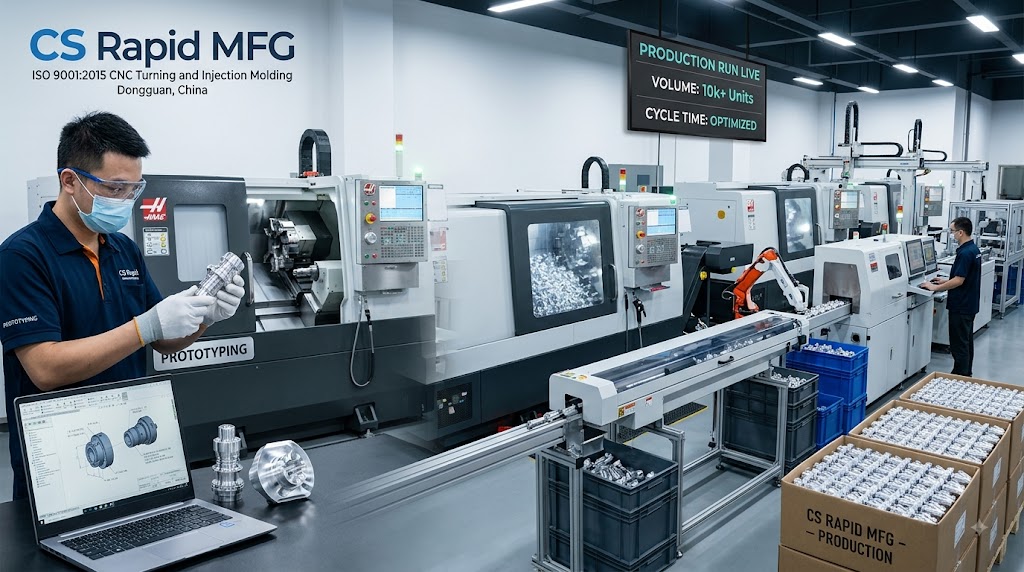
In precision CNC turning, transitioning from prototype to serial production requires a shift in mindset. While prototyping prioritizes design speed and iteration flexibility, production runs focus heavily on unit cost reduction, cycle time optimization, and consistent quality control.
This guide outlines the critical steps to scale your custom turned parts seamlessly from early-stage prototypes to high-volume serial production.
Balancing Prototyping Speed with Production Efficiency
During the prototyping stage, the lathe or multi-axis turning center is programmed to manufacture one or two parts at a time. Setup time is a significant cost factor, and material efficiency is often secondary to getting a physical part in hand quickly.
In contrast, production CNC turning is all about maximizing machine uptime and minimizing the cost per part. Achieving this requires optimizing every element of the manufacturing process, from raw material procurement to automated material handling.
- Automation with Bar Feeders: While prototype stock is often loaded manually, production turning utilizes automated bar feeders. These devices continuously feed raw bar stock into the lathe’s spindle, enabling automated machining with minimal manual intervention.
- Cycle Time Reduction: In production runs, shaving even five seconds off a part’s machining time can save thousands of dollars over a large batch. Programmers will carefully refine tool paths, spindle speeds, and feed rates to maximize efficiency.
Critical Steps to Prepare Your Turned Parts for High-Volume Production
To ensure a smooth and cost-effective transition from a validated prototype to full production, incorporate these critical scaling strategies into your engineering roadmap:
1.Freeze the CAD Model and Execute a DFM Review
Before launching a production run, your CAD geometry must be finalized and optimized for high-volume manufacturing. Minor geometry details that are acceptable on a single prototype can lead to high scrap rates or slow cycle times when multiplied by thousands of units.
Before releasing your design for mass production, review our Smart DFM Design Strategies to Reduce CNC Turning Expenses to identify critical geometry updates.
2.Re-evaluate Tolerances for Bulk Processing
Tight dimensional tolerances (such as under ±0.02 mm) require constant monitoring, slower machining feeds, and frequent tool changes. While appropriate for critical mating features, applying these tight constraints to non-functional surfaces on a production part will unnecessarily inflate your unit costs.
To learn how to balance dimensional limits with production economics, consult our Guide to CNC Machining Precision and Tolerances.
3. Streamline Secondary Surface Finishes
Applying manual polishing or custom, multi-step cosmetic coatings to a few prototypes is manageable. However, when scaling to serial production, you should specify surface finishes that can be processed efficiently in batches—such as bulk bead blasting or automated anodizing.
Discover how different finishing options affect manufacturing lead times in our Overview of Common Surface Finishes for CNC Parts.
4. Leverage Bulk Material Purchasing
Prototyping often relies on off-the-shelf raw material stock purchased in small quantities. When transitioning to production runs, work with your manufacturer to source raw materials in bulk. This drastically reduces the bill of materials (BOM) cost and ensures material consistency across the entire production lot.
Partner with CS Rapid MFG for End-to-End Solutions
Navigating the transition from a physical prototype to high-volume serial production requires a manufacturing partner with the capacity, technology, and engineering expertise to guide your project. At CS Rapid MFG, we bridge the gap between design and delivery by supporting your hardware product through its entire lifecycle.
Established in 2008 and based in Dongguan, China, our advanced facility is proudly ISO 9001:2015 certified. We house over 80 domestic and foreign high-precision CNC machines alongside over 60 injection molding machines, supported by a dedicated team of more than 100 experienced technicians.
To see how our complete manufacturing ecosystem scales your parts from R&D to the assembly line, read The Ultimate Guide to CNC Machining.
Why CS Rapid MFG is the Ideal Manufacturing Partner:
Seamless Scalability: We handle everything under one roof—from a single rapid prototype for validation to tens of thousands of end-use production parts.
Lightning-Fast Turnaround: We shorten pilot production cycles, with custom turned parts manufactured and delivered in as fast as 5 days.
Complimentary Engineering DFM: Every quote request receives a preliminary Design for Manufacturability (DFM) review within 12 hours, helping you optimize tool paths and material choices for production.
Exceptional Global Value: Enjoy high-precision manufacturing at pricing +30% lower than western competitors while maintaining global quality standards.
No Minimum Order Quantity (MOQ): We support agile hardware startups with zero MOQ requirements for prototyping, allowing you to scale up on your own timeline.
Ready to take your project from prototype to production? Contact CS Rapid MFG today or upload your 2D and 3D CAD files to receive a comprehensive quote within 12 hours.