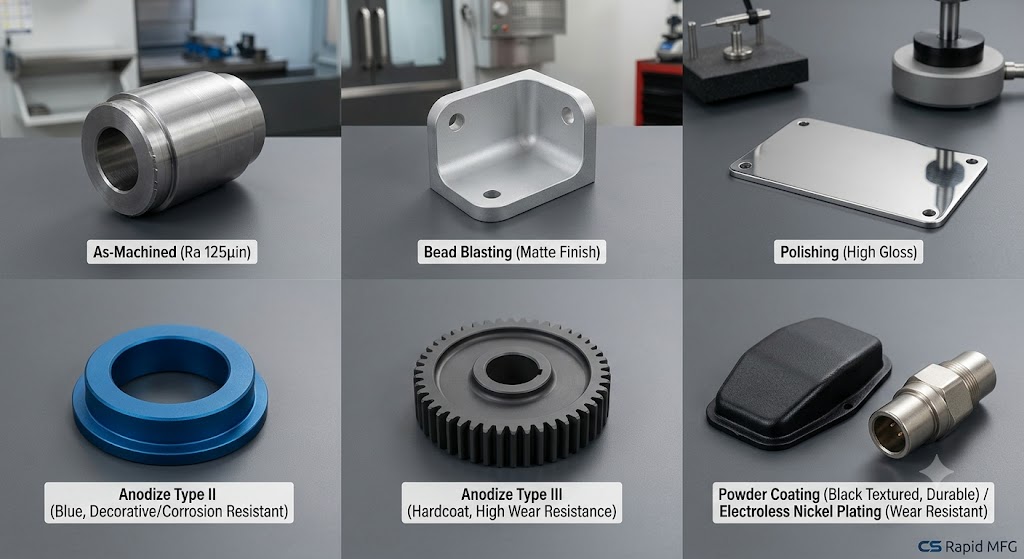
While Computer Numerical Control (CNC) machining delivers exceptional dimensional accuracy and tight tolerances, parts coming directly off a lathe or milling machine may still retain subtle tool marks or sharp edges. To enhance visual appearance, improve corrosion resistance, reduce friction, or prepare components for harsh operational environments, applying secondary surface finishes is essential.
Choosing the right post-processing treatment depends on part geometry, material substrate (metal vs. plastic), environmental exposure, and performance requirements.
This guide breaks down the most common surface finishing options for CNC turned and milled parts—from standard as-machined textures to advanced electrochemical coatings—and explains how post-processing elevates part quality.
As-Machined Finish Standard Smoothness and Economy
The as-machined finish leaves the workpiece directly in its raw state after machining operations are complete. It is the quickest and most cost-effective option because it requires no secondary post-processing steps.
- Surface Roughness: For turned cylindrical features, the lathe naturally achieves a very smooth surface finish, typically yielding a surface roughness of around Ra 125 µin.
- Tool Marks: Areas cut with live tooling—such as milled flats, slots, and radial holes—may retain visible tool marks or light burrs. Sharp edges are typically deburred or broken by default during inspection.
- Best For: Internal mechanical components, rapid functional prototypes, and cost-sensitive assemblies where cosmetic appearance is secondary to dimensional fit.
Abrasive and Mechanical Finishes Bead Blasting and Polishing
Mechanical surface treatments use physical abrasion or friction to modify part texture.
Bead Blasting
Bead blasting propels fine abrasive particles (such as glass beads) under high pressure against the part’s surface.
- Appearance: Creates a uniform, non-reflective matte or satin texture across the entire component.
- Function: Effectively removes visible tool marks, minor surface scratches, and burrs.
- Best For: Consumer electronics housings, optical equipment, and non-glare industrial parts made from aluminum, stainless steel, or titanium.
Sanding and Polishing
Polishing uses progressively finer abrasive compounds to smooth the surface, removing tool lines to create a refined texture with varying gloss levels. High-grade mirror polishing reduces surface roughness significantly, which is critical for reducing friction in dynamic seals and fluid fittings.
Anodizing Superior Corrosion and Wear Resistance for Aluminum
Anodizing is an electrochemical process widely applied to aluminum alloys (such as 6061 and 7075) to convert the native oxide layer into a durable, protective anodized finish.
- Anodize Type II (Standard): Creates a corrosion-resistant oxide layer. The porous oxide structure can be dyed in vibrant colors—such as clear, black, red, blue, and gold—providing excellent cosmetic aesthetics alongside environmental protection.
- Anodize Type III (Hardcoat): Produces a much thicker, denser oxide layer. Type III hardcoat anodizing drastically increases surface hardness and provides exceptional wear and abrasion resistance for heavy-duty operational components.
Protective Coatings Powder Coating and Plating
When components face aggressive chemicals, outdoor environments, or heavy mechanical wear, advanced surface coatings provide an extra layer of defense.
Sanding and Polishing
Polishing uses progressively finer abrasive compounds to smooth the surface, removing tool lines to create a refined texture with varying gloss levels. High-grade mirror polishing reduces surface roughness significantly, which is critical for reducing friction in dynamic seals and fluid fittings.
Anodizing Superior Corrosion and Wear Resistance for Aluminum
Anodizing is an electrochemical process widely applied to aluminum alloys (such as 6061 and 7075) to convert the native oxide layer into a durable, protective anodized finish.
- Anodize Type II (Standard): Creates a corrosion-resistant oxide layer. The porous oxide structure can be dyed in vibrant colors—such as clear, black, red, blue, and gold—providing excellent cosmetic aesthetics alongside environmental protection.
- Anodize Type III (Hardcoat): Produces a much thicker, denser oxide layer. Type III hardcoat anodizing drastically increases surface hardness and provides exceptional wear and abrasion resistance for heavy-duty operational components.
Protective Coatings Powder Coating and Plating
When components face aggressive chemicals, outdoor environments, or heavy mechanical wear, advanced surface coatings provide an extra layer of defense.
Powder Coating
Powder coating involves electrostatically spraying a fine dry powder onto the metal part, which is then cured under heat to form a hard skin. It delivers a tough, uniform layer that is significantly more durable and impact-resistant than conventional liquid paint. A wide range of colors and textures is available.
Electroplating and Electroless Nickel Plating
Plating deposits a thin metallic layer onto the workpiece surface via chemical or electrochemical reaction:
- Electroless Nickel Plating: Deposit a uniform nickel-phosphorus layer across all surfaces—including deep internal cavities—enhancing wear resistance, surface hardness, and corrosion protection.
- Passivation: Essential for stainless steel components (such as 304, 316, and 17-4 PH). Passivation treats the steel with an acid solution to remove free iron contamination from machining, restoring the material’s natural corrosion resistance.
- Black Oxide and Chromate Conversion: Black oxide adds mild corrosion resistance and a non-reflective black finish to steel components, while chromate plating (Alodine) protects aluminum while preserving electrical conductivity.
How to Select the Right Surface Finish
When choosing a secondary finishing process, evaluate these key design criteria:
- Environmental Exposure: Outdoor, marine, or medical environments mandate high-tier protection like Anodize Type III, Passivation, or Electroless Nickel Plating.
- Dimensional Tolerances: Plating and hardcoat anodizing add measurable thickness to part dimensions. Ensure critical feature tolerances account for coating buildup.
- Cosmetic Requirements: For consumer-facing products, bead blasting paired with Type II color anodizing delivers a premium matte aesthetic.
- Cost Optimization: [To explore how combining the right finishing choices with smart DFM guidelines reduces total manufacturing costs, read our complete DFM Optimization Guide].
Quality Assured Finishing Solutions at CS Rapid MFG
Whether your components require precision 5-axis CNC milling, high-speed lathe turning, or custom protective surface finishes, CS Rapid MFG offers complete end-to-end manufacturing solutions.
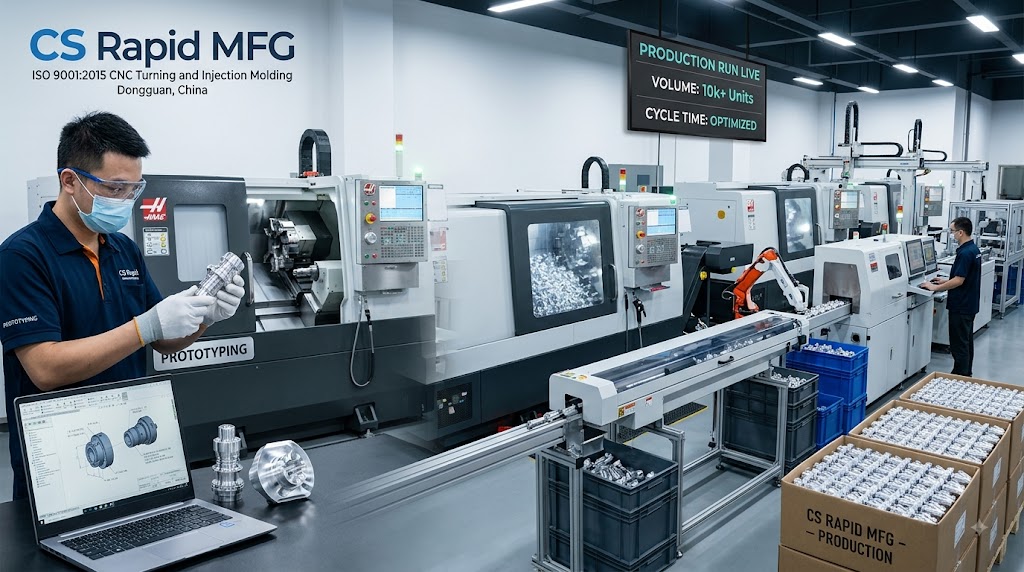
Operating out of Dongguan, China, our advanced manufacturing facility strictly adheres to ISO quality management standards and is proudly ISO 9001:2015 certified. Our project engineers perform rigorous dimensional, tolerance, and appearance inspections at every stage of production to ensure your parts meet exact specifications.
Why Choose CS Rapid MFG:
Fast Lead Times: Complete custom machined and finished parts delivered in as fast as 5 days.
No Minimum Order Quantity (MOQ): Support for 1-off functional prototypes up to high-volume production.
Competitive Global Pricing: Enjoy high-precision quality with pricing +30% lower than western competitors.
Comprehensive DFM Review: Receive a free preliminary Design for Manufacturability (DFM) analysis within 12 hours of submitting your request.
Ready to elevate your CNC parts with professional surface finishes? Contact CS Rapid MFG today or upload your 2D and 3D CAD files to receive an instant quote within 12 hours.