In today’s fast-paced and highly competitive manufacturing landscape, the demand for high-quality, precise, and quickly delivered parts has never been greater. Whether you are an engineer validating a new product design or a purchasing manager looking to scale up to mass production, understanding your manufacturing partner’s capabilities is crucial.
Computer Numerical Control (CNC) machining stands as one of the most reliable and versatile subtractive manufacturing technologies available today. By using programmable computer instructions—known as G-code—to control advanced machinery, CNC machining removes material from a solid block or rod to create a highly accurate final product.
In this comprehensive guide, we will explore the core technologies behind CNC machining, how to select the right materials and finishes, the importance of Design for Manufacturability (DFM), and why CS Rapid MFG is your ultimate partner for taking your project from a rapid prototype to full-scale end-use production.
Core Capabilities: CNC Milling vs. CNC Turning
At the heart of modern precision manufacturing are two primary processes: CNC Milling and CNC Turning. While both are subtractive processes, they operate on entirely different mechanical principles to achieve complex geometries.
CNC Milling
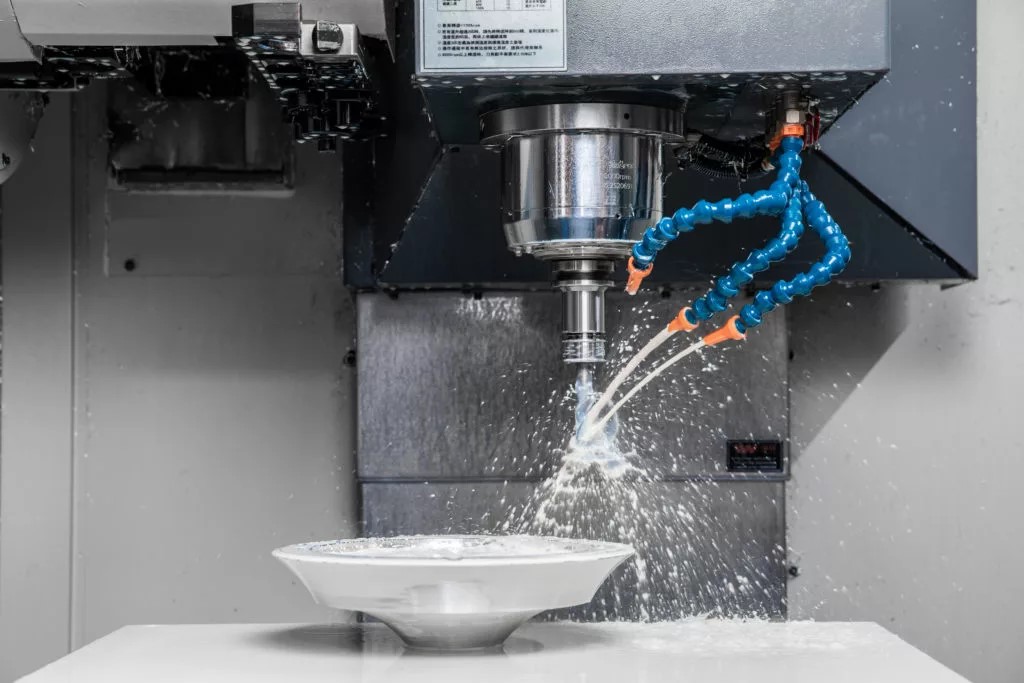
Mastering Complex 3D Geometries. In CNC milling, the raw material (workpiece) is held firmly in place on the machine bed while high-speed cutting tools rotate around it along multiple axes (X, Y, and Z) to remove material. This makes milling exceptionally well-suited for creating complex, three-dimensional prismatic shapes, flat surfaces, and intricate internal cavities.
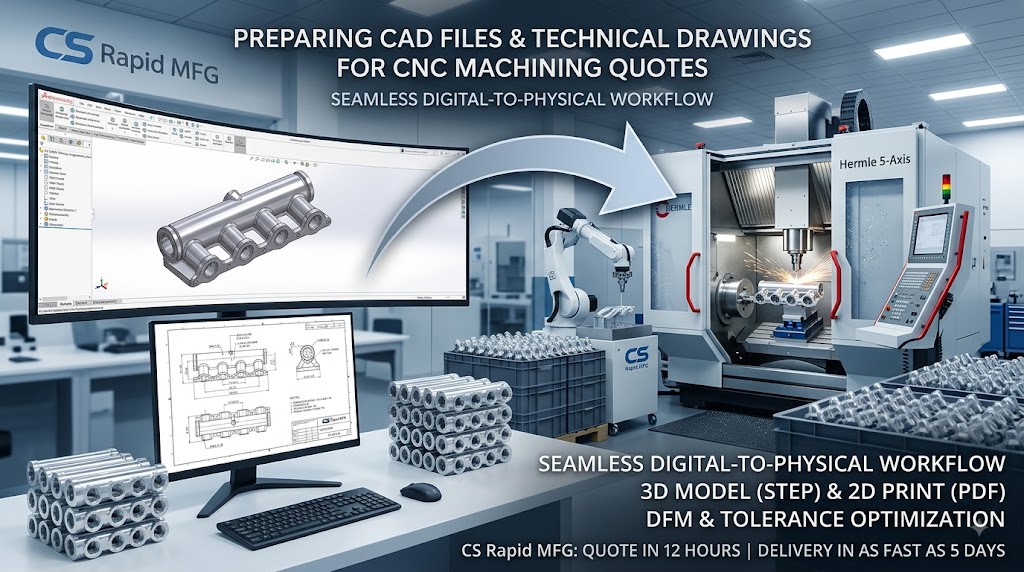
At CS Rapid MFG, we push the boundaries of traditional milling. Our facilities are equipped with state-of-the-art Hermle and DUG 5-axis, 4-axis, and 3-axis precision milling machines. 5-axis machining allows the cutting tool to move across five different axes simultaneously, enabling the production of highly complex parts with fewer setups, tighter tolerances, and superior surface finishes.
CNC Turning
The Standard for Symmetrical Precision. Conversely, CNC turning operates by placing a blank bar of stock material into a chuck and rotating it at high speeds along a stationary axis. A stationary cutting tool is then fed into the spinning raw material to progressively shape it. Because the material itself is rotating, turning is the most efficient and accurate method for manufacturing symmetrical, cylindrical, tubular, or spherical parts such as shafts, rods, pins, and spacers.
However, modern turning goes far beyond simple cylinders. Our advanced CNC lathes are equipped with live tooling. This technology allows the lathe to perform secondary milling operations—such as drilling axial and radial holes, cutting slots, and machining flat surfaces (flats)—without ever needing to remove the part and transfer it to a separate milling machine. This combined approach drastically reduces setup times and lowers overall production costs.
Navigating Material Selection for CNC Machining
One of the greatest advantages of CNC machining is its vast material compatibility. Unlike other processes that are limited to specific resins or powders, CNC machines can cut through incredibly hard metals and robust engineering plastics.
High-Performance Metals
Aluminum (6061, 7075)
Lightweight, easy to machine, and offering excellent corrosion resistance. It is heavily utilized in aerospace, automotive, and consumer electronics.
Stainless Steel (304, 316, 17-4PH): Known for its exceptional strength and high resistance to corrosion, making it perfect for medical devices, kitchen appliances, and harsh environments.
Titanium (Grade 2, Grade 5)
Boasts an incredible strength-to-weight ratio and is highly biocompatible. It can withstand extreme temperatures, making it a premium choice for aerospace engine components and surgical implants.
Brass & Copper
Brass (C360) offers superior machinability and low friction, while Copper (C110) provides unmatched thermal and electrical conductivity for electronic hardware and heat exchangers.
Durable Engineering Plastics
ABS & POM (Delrin)
ABS is a highly versatile and cost-effective plastic for general prototyping. POM offers high strength and low friction, making it the industry standard for plastic gears, bearings, and precision mechanical components.
PEEK & PEI
These are advanced, high-performance thermoplastics. PEEK offers incredible heat resistance and chemical stability, often replacing metal parts in aerospace and medical applications.
Surface Finishes That Elevate Your Parts
The CNC machining process naturally yields parts with excellent dimensional accuracy, but applying the right secondary surface finish is essential for enhancing aesthetics, wear resistance, and longevity.
As-Machined
Parts leave the machine with visible tool marks. For cylindrical turned parts, this finish is typically very smooth, often achieving a surface roughness of Ra 125 µin.
Bead Blasting
Fine abrasive particles are propelled against the part to remove tool marks, resulting in a smooth, non-reflective matte texture.
Anodizing (Type II & Type III)
An electrochemical process primarily used for aluminum. Type II adds corrosion resistance and allows for custom color dyeing, while Type III (Hardcoat) creates a significantly thicker, wear-resistant layer for heavy-duty applications.
Powder Coating & Plating
Powder coating provides a highly durable and uniform colored layer. Plating processes (like Electroless Nickel) enhance surface hardness and provide a premium metallic aesthetic.
Scaling Up: From Rapid Prototyping to Mass Production
Product development is a journey, and CS Rapid MFG is designed to support you at every single stage.
Rapid Prototyping Phase
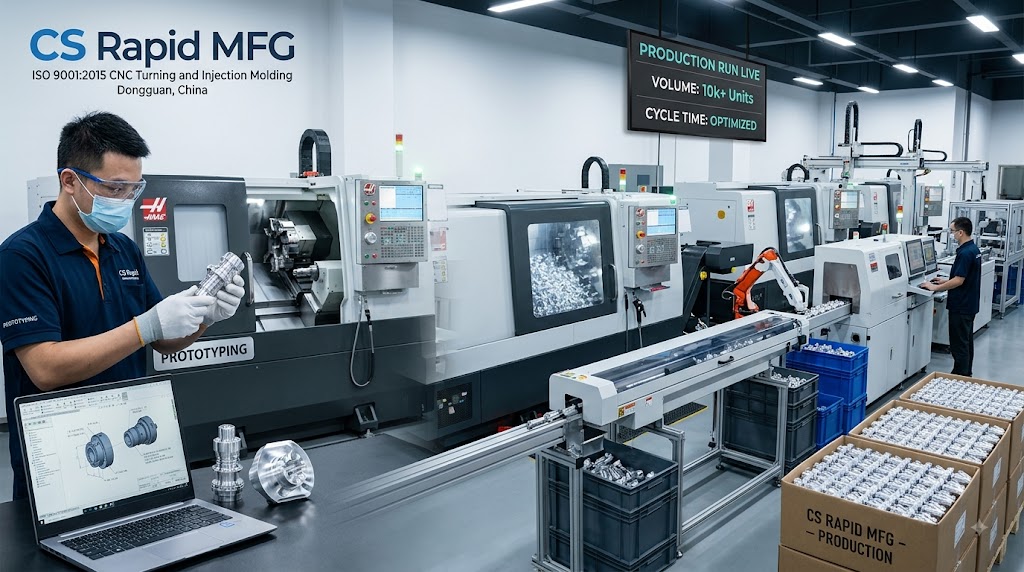
When you are bringing a new idea to life, speed is critical. CNC machining is the ideal rapid prototyping method because it allows engineers to test the physical properties of the exact end-use material, unlike many 3D printing alternatives. We empower startups and design agencies by offering a strict No Minimum Order Quantity (MOQ) policy—meaning you can order just a single prototype to validate your design.
Low-Volume and End-Use Production
Once your prototype is approved, transitioning to production is seamless. Because CNC machining relies on precise computer code, the repeatability is flawless; the 10,000th part will be identical to the very first. For high-volume serial production, our facilities utilize automated bar feeders on our turning centers to continuously feed raw material into the spindle, dramatically reducing labor costs and slashing lead times.
Design for Manufacturability (DFM): Optimizing Your Costs
Smart engineering decisions can significantly lower your manufacturing expenses. Design for Manufacturability (DFM) is the practice of designing parts specifically to make them easier and cheaper to produce.
Key design tips for CNC turning include:
Standardize Outer Diameters: Whenever practical, design your part’s outside diameter (OD) to be slightly smaller than standard raw bar stock sizes. This minimizes the amount of material that needs to be cut away.
Manage Length-to-Diameter Ratios: Avoid designing excessively long, thin structures that can deflect or vibrate under cutting pressure. Deep, precise internal holes become significantly more difficult and expensive to machine when the depth-to-diameter ratio exceeds 10:1.
Avoid Sharp Internal Corners: Cutting tools are inherently round. Designing parts with radiused corners rather than sharp 90-degree internal angles allows the machine to work faster and more efficiently.
To ensure your success, CS Rapid MFG provides a comprehensive, free preliminary DFM analysis report the moment your order is confirmed. Our engineers proactively review your tolerances, dimensions, and specifications to identify potential issues before a single piece of metal is cut.
Why Trust CS Rapid MFG as Your Manufacturing Partner?
Finding a manufacturer is easy; finding a reliable manufacturing partner is hard. CS Rapid MFG was established in 2008 in Dongguan, China—the heart of global manufacturing innovation. Over the years, we have grown into a powerhouse facility equipped with over 80 high-precision CNC processing machines and a dedicated team of over 100 skilled technical professionals.
Here is why innovative companies worldwide trust us with their most critical components:
Uncompromising Quality Control: We operate under strict ISO quality standards and are proudly ISO 9001:2015 certified. Our robust inspection processes ensure every part meets tight tolerances (down to ±0.005 inches or ±0.13mm).
Lightning-Fast Turnaround: In the modern market, time is money. We are committed to shortening pilot production cycles, offering part manufacturing and delivery in as fast as 5 days.
Unbeatable Cost Efficiency: By leveraging our highly optimized in-house manufacturing lines and global supply chain networks in China, we routinely offer pricing that is +30% lower than western competitors—without ever sacrificing quality.
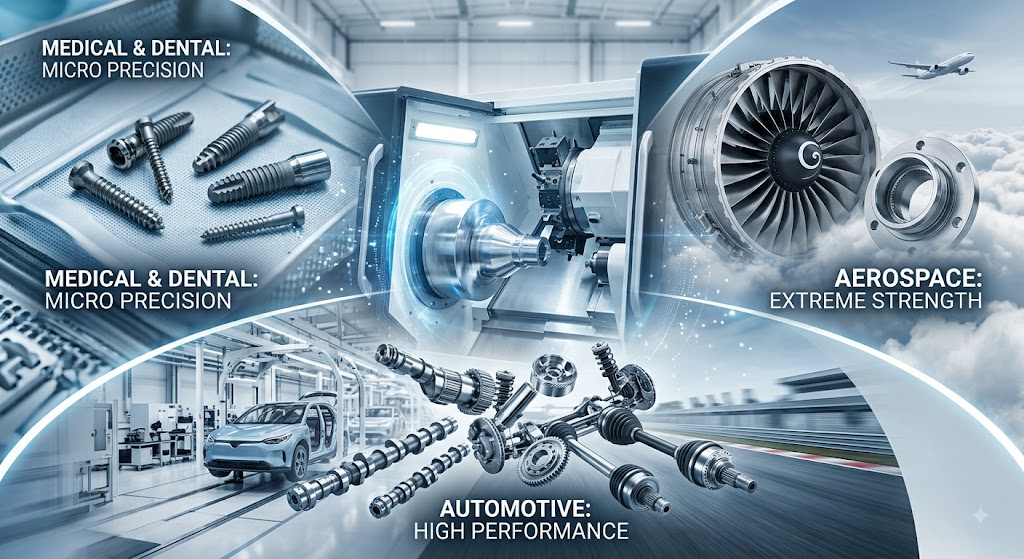
Proven Track Record: Since our establishment, we have successfully delivered over 15,000 projects to highly satisfied clients across the aerospace, automotive, medical, and robotics industries worldwide.
Ready to Start Your Next Project?
Whether you need a one-off complex 5-axis milled prototype or a high-volume production run of precision turned cylindrical parts, CS Rapid MFG has the technology, the talent, and the capacity to bring your vision to reality.
Stop waiting weeks for quotes and production runs. Get an Instant Quote today by simply sharing your 2D or 3D CAD files and project specifications with us. Our engineering team will review your files and provide a precise, competitive quotation within 12 hours.
Manufacture with precision. Manufacture with speed. Manufacture with CS Rapid MFG.