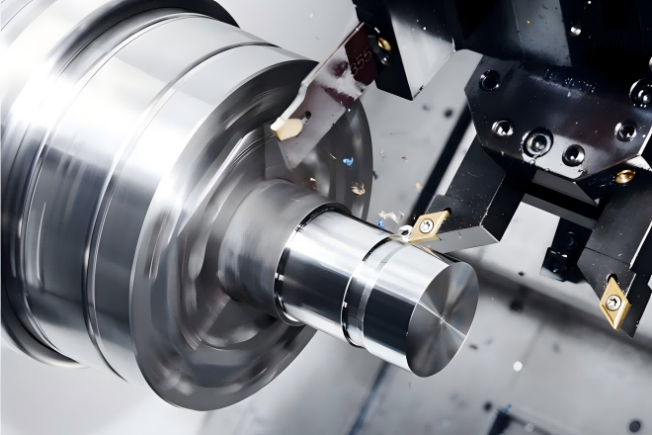
In the traditional world of subtractive manufacturing, the division of labor was strictly defined: if a part required symmetrical, cylindrical features, it went to the CNC lathe (turning); if a part required flat surfaces, asymmetric contours, or complex holes, it went to the CNC mill.
However, modern engineering designs frequently combine both cylindrical and prismatic features. Moving a workpiece back and forth between a lathe and a mill adds significant setup time, increases manufacturing costs, and introduces the risk of alignment errors.
Enter the game-changer in modern manufacturing: the CNC lathe equipped with live tooling. In this article, we will explore what live tooling is, the complex features it can create, and how this technology drastically reduces production times and costs.
What is a CNC Lathe with Live Tooling?
A conventional 2-axis CNC lathe operates by holding a blank bar of raw material in a chuck and rotating it at high speeds against a stationary cutting tool. While this is incredibly efficient for creating purely round shapes, it is limited to rotational symmetry.
A CNC lathe with live tooling breaks this limitation. In addition to standard stationary turning tools, the machine’s turret is equipped with driven, motorized rotary tools. This means that while the main workpiece is held securely in the spindle, these active cutting tools can perform secondary milling, drilling, and tapping operations directly on the part.
Essentially, a live tooling lathe functions as a hybrid machine. It can stop the rotation of the workpiece, lock the spindle at a precise angle, and use a rotating end mill or drill bit to carve out features that would traditionally require a completely separate CNC milling machine.
Features Machined with Live Tooling
By integrating milling capabilities into the turning center, live tooling allows engineers to design highly complex cylindrical components without worrying about exorbitant machining costs.
Here are the most common features that CNC lathes with live tooling can effortlessly machine into a workpiece:
Axial and Radial Holes: Traditional lathes can only drill straight down the center axis of a part. With live tooling, the machine can drill holes radially (into the side of the cylinder) or axially (off-center holes on the face of the part).
Flats and Wrench Flats: If your cylindrical shaft requires flat sections so it can be gripped by a wrench or mated against a flat surface, live tooling can mill these flat faces directly onto the outer diameter.
Grooves and Slots: Driven tools can cut precise keyway slots, O-ring grooves, and complex contoured pockets along the length or the face of the turned part.
Advanced Threading: Beyond basic single-point threading for the outside diameter (OD) and inside diameter (ID), live tooling can tap off-center holes or create custom threaded features efficiently.
Unmatched Advantages of Live Tooling
Integrating live tooling into your manufacturing strategy offers several profound advantages, especially when moving from rapid prototyping to low-volume production:
The “Done-in-One” Approach (Reduced Setup Time)
The primary benefit of live tooling is the elimination of multiple machine setups. In the past, a part would be turned on a lathe, manually removed, re-fixtured onto a milling machine, and then milled. Live tooling allows a part to be completely finished in a single setup without having to move the workpiece to a different machine. This drastically reduces setup times and cuts down on expensive manual labor.
Improved Precision and Alignment
Every time a part is removed from a machine and re-clamped into another fixture, there is a risk of losing the “zero” reference point, which can lead to slight tolerance deviations. Because a live tooling lathe machines all the turned and milled features in one continuous operation without unclamping the part, the feature-to-feature alignment and overall dimensional accuracy are vastly superior.
Shorter Lead Times and Lower Costs
By streamlining the manufacturing process and eliminating the queue times between different machining stations, live tooling accelerates the entire production cycle. This efficiency translates directly into lower manufacturing costs and significantly faster delivery times for the customer.
Design for Manufacturability (DFM): Quick Tips for Live Tooling
While live tooling provides incredible flexibility for complex geometries, keeping a few foundational Design for Manufacturability (DFM) principles in mind will help ensure your parts are machined efficiently and flawlessly on the first try:
Standardize Outer Diameters (OD): If practical, choose an outside diameter that is slightly smaller than a standard raw bar stock size. This minimizes the amount of material that needs to be cut away.
Manage Proportions: Avoid flimsy shapes that will deflect due to cutting pressure. The optimum length-to-diameter ratio is around 2:1 or 3:1. Furthermore, precision holes become highly challenging when the depth-to-diameter ratio exceeds 10:1.
Avoid Sharp Internal Corners: Cutting tools are inherently round. Always try to use a radius instead of sharp 90-degree internal corners to allow for smooth tool paths.
Maintain Safe Wall Thicknesses: When designing thin-walled turned parts, ensure the wall thickness is greater than 0.020 inches (0.51mm). Walls thinner than this typically do not survive the machining process.
While these foundational rules will help stabilize your complex parts during live tooling operations, true cost optimization requires a deeper dive into your CAD file. [Want to learn more about reducing manufacturing expenses? Read our comprehensive Guide to Design for Manufacturability (DFM) in CNC Turning], where we explore advanced strategies for thread depth optimization, tolerance management, and material selection to help you save on your next project.
Elevate Your Production with CS Rapid MFG
Whether your project requires simple cylindrical spacers or highly complex shafts featuring off-center radial holes and milled flats, CS Rapid MFG has the technology and expertise to deliver your parts flawlessly.
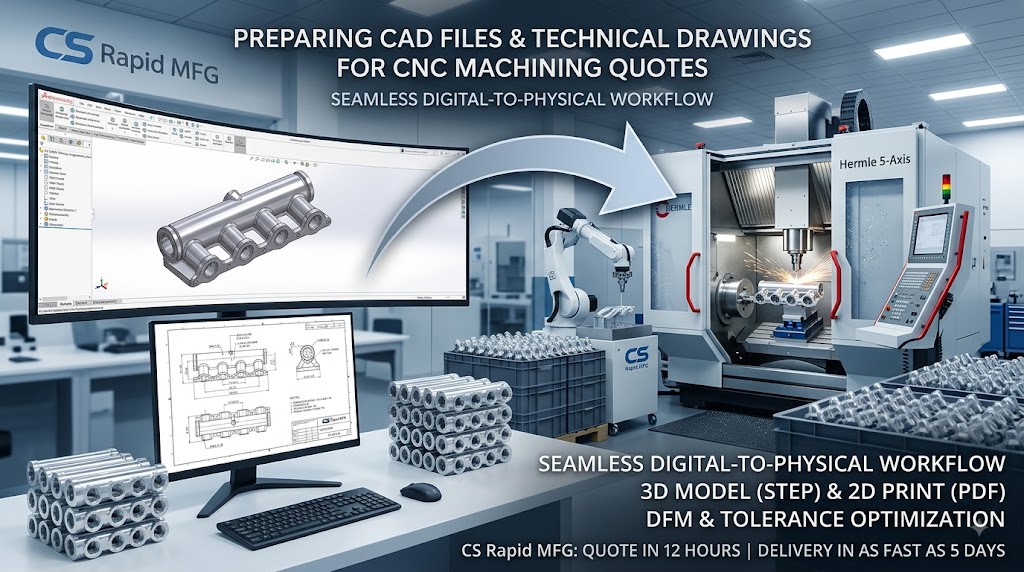
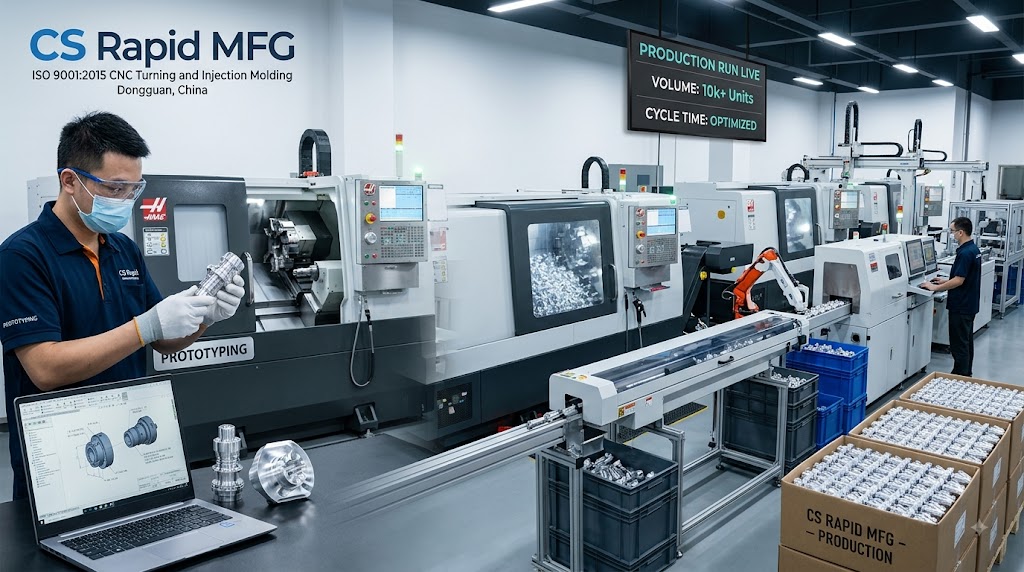
Located in Dongguan, China, our advanced manufacturing facility is equipped with over 80 domestic and foreign high-precision CNC processing machines, including top-tier CNC lathes and Hermle/DUG 5-axis milling centers.
Why Innovative Companies Trust CS Rapid MFG:
Quick Turnaround: We are committed to shortening pilot production cycles. Through technologies like live tooling, we can manufacture and deliver custom parts in as fast as 5 days.
No Minimum Order Quantity (MOQ): From a single rapid prototype to thousands of end-use production parts, we offer total flexibility without strict MOQ requirements.
ISO Certified Quality: We strictly adhere to global quality standards and are proudly ISO 9001:2015 certified, ensuring that every part that leaves our facility meets your exact specifications.
Free DFM Analysis: Once you submit your inquiry, our team of over 100 skilled technicians will provide a preliminary Design for Manufacturability (DFM) report to help optimize your design for our live tooling lathes.
Ready to leverage the power of advanced CNC turning? Stop paying for multiple setups. Contact CS Rapid MFG today or share your 2D and 3D CAD files for a precise, instant quote within 12 hours. Let us turn your complex designs into reality.