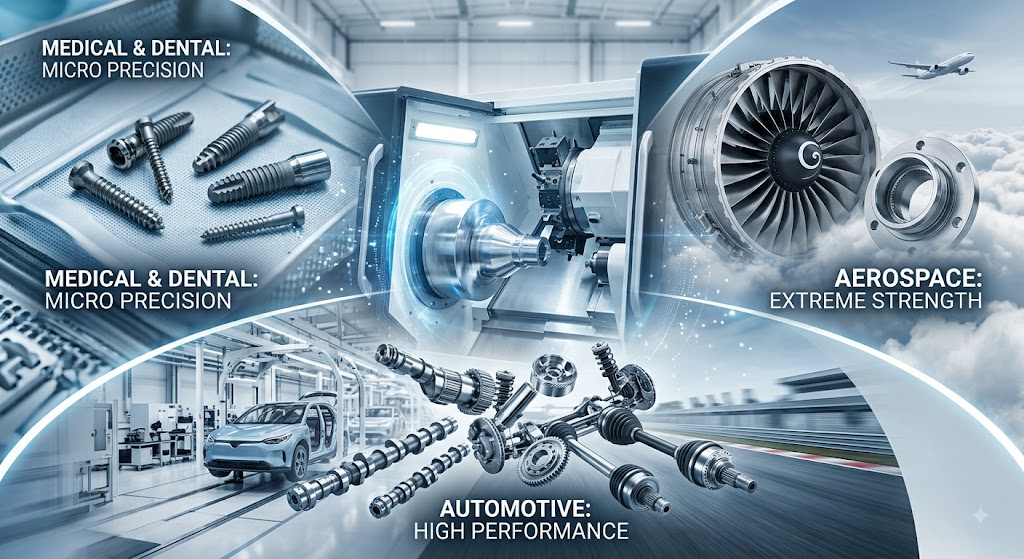
In the realm of modern digital manufacturing, component production depends on selecting the optimal fabrication path. While both techniques excel at carving prototypes and end-use parts out of solid metal and plastic blocks with outstanding repeatability, they operate on entirely different mechanical principles. Utilizing the wrong manufacturing path can lead to inflated production costs, longer lead times, and compromise the structural integrity of your part.
To maximize your budget and ensure outstanding part performance, selecting the right partner with versatile [precision CNC machining services] is essential to guide your design from initial concept through serial production.
The Fundamental Mechanical Difference
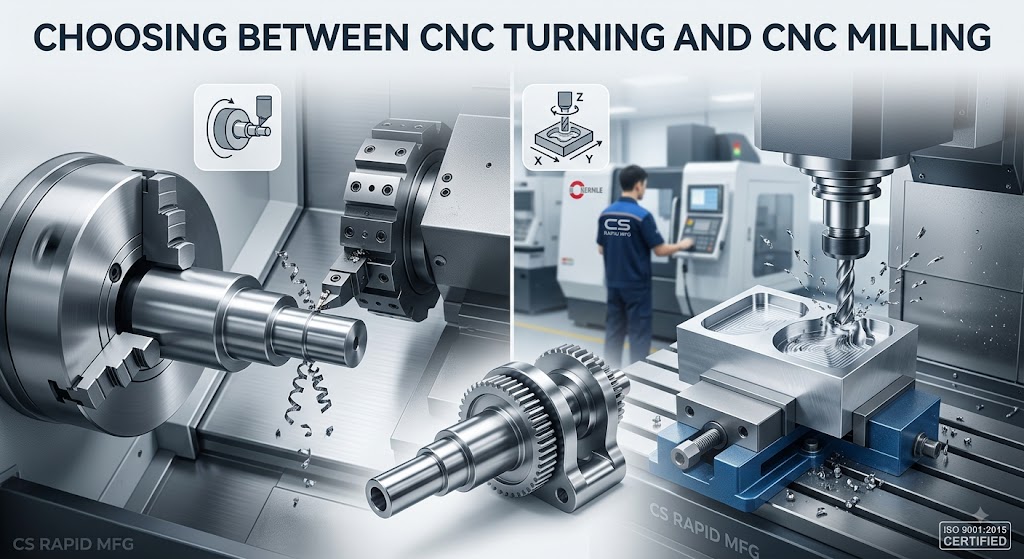
The difference between turning and milling lies primarily in which component moves—the raw material or the cutting tool.
CNC Turning
In CNC turning, the raw material bar is loaded into a chuck and rotated at high speeds along a stationary axis. The cutting tool remains fixed in a tool turret and is fed linearly into the spinning material to progressively shave away unwanted volume. Because the process is driven by the rotation of the material itself, it is inherently designed to create symmetrical, cylindrical, or spherical shapes.
CNC Milling
In CNC milling, the raw material is clamped securely in a stationary vise or fixture on the machine bed. The cutting tools are mounted in a spindle that rotates at high speeds. This spindle moves along multiple axes (X, Y, and Z) to engage with the stationary block, cutting away material from various angles to create complex three-dimensional shapes.
When to Choose CNC Turning for Your Project
CNC turning centers and lathes are highly specialized tools. You should prioritize our high-speed [custom CNC turning services] if your design exhibits the following characteristics:
- Rotational Symmetry: If your custom parts are primarily round, tubular, or symmetrical along a central axis—such as stepped shafts, pins, axles, collars, bushings, and washers—CNC turning is the absolute standard.
- Superior Surface Roughness: Because the lathe moves a single-point cutting tool continuously along a rotating workpiece, it naturally achieves exceptionally smooth finishes on cylindrical outer and inner diameters, typically reaching low surface roughness without heavy secondary processing.
- High-Volume Cost Efficiency: For batch production of round parts, lathes are significantly faster and more economical than milling machines, utilizing automated bar feeders to continuously load raw stock and minimize manual labor.
When to Choose CNC Milling for Your Project
CNC milling is the go-to process for parts that cannot be rotated or do not feature cylindrical shapes. For parts featuring complex prismatic geometries, organic 3D surfaces, and flat pockets, utilizing specialized [multi-axis CNC milling services] guarantees exceptional surface finishes. You should select CNC milling if your project involves:
Asymmetrical and Prismatic Geometries: Parts with flat faces, sharp right angles, deep internal cavities, pockets, and organic, free-flowing 3D surfaces must be milled.
Complex Multi-Axis Features: If your component requires intricate detailing across multiple faces, 3-axis, 4-axis, or 5-axis milling centers can manipulate the tool or the part in space to machine complex features without manual re-fixturing.
Combining Turning and Milling for Advanced Geometries
Many advanced 3D CAD models are not purely cylindrical or purely flat—they contain a mix of both features. For example, a drive shaft might require a perfectly turned cylindrical body but also feature milled flats for wrench grips, keyway slots for gears, or off-center drilled holes.
Historically, manufacturing such parts required sequential processing: turning the part on a lathe, manually unclamping it, and setting it up on a milling machine. This traditional multi-setup workflow added labor costs and introduced alignment tolerances.
Modern machine shops bridge the gap between these techniques by utilizing [multi-axis CNC turning with driven live tools] to complete parts in a single operation. This multi-axis capability allows them to perform multiple machining operations—such as milling, drilling, and tapping—without having to move the workpiece to a different machine, making them extremely cost-effective for complex turned parts.
Key Decision Factors for Project Managers
- When selecting a manufacturing process for your custom part, evaluate your design against these critical criteria to optimize your budget:
- Part Geometry: Does the part have a dominant cylindrical axis? If yes, start with turning. If the part is boxy, flat, or highly organic, use milling.
- Required Tolerances: While both methods achieve extreme precision, turning centers have a natural mechanical advantage when holding tight concentricity on shafts and bores. While both methods achieve high accuracy, their mechanical setups influence physical limits; choose the right process by studying [dimensional precision capabilities of CNC machines].
- Material and Feature Constraints: Soft plastics and hard metals behave differently on lathes and mills. Understanding how cutting tools engage with the workpiece allows you to implement [cost-saving geometry designs for CNC machined parts] before starting production.
Streamline Your Production with CS Rapid MFG
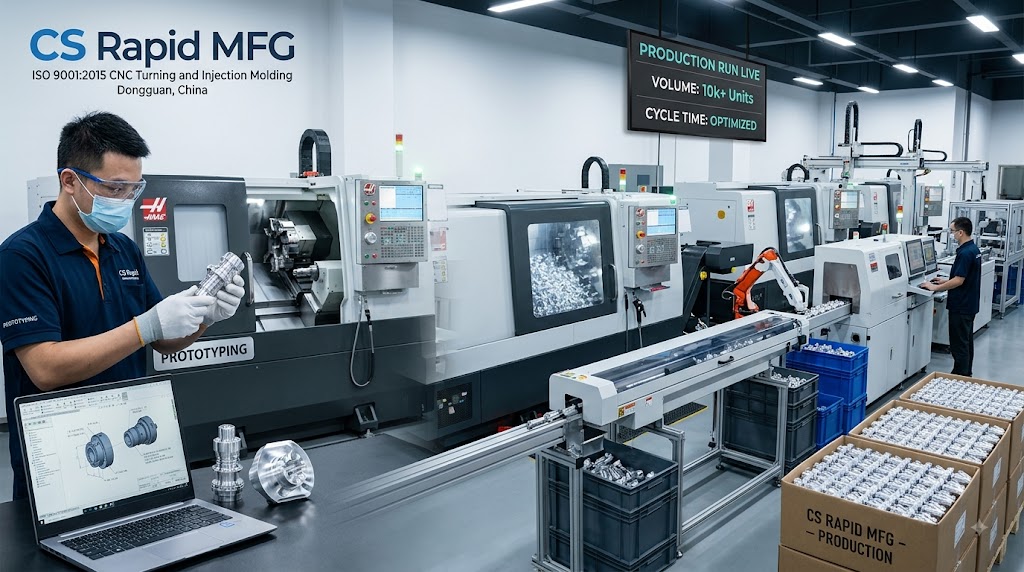
Choosing the right CNC machining process is vital, but having a skilled manufacturing partner to execute the work is equally important. At CS Rapid MFG, we eliminate the guesswork by providing robust, in-house capabilities for both CNC turning and multi-axis CNC milling under one roof.
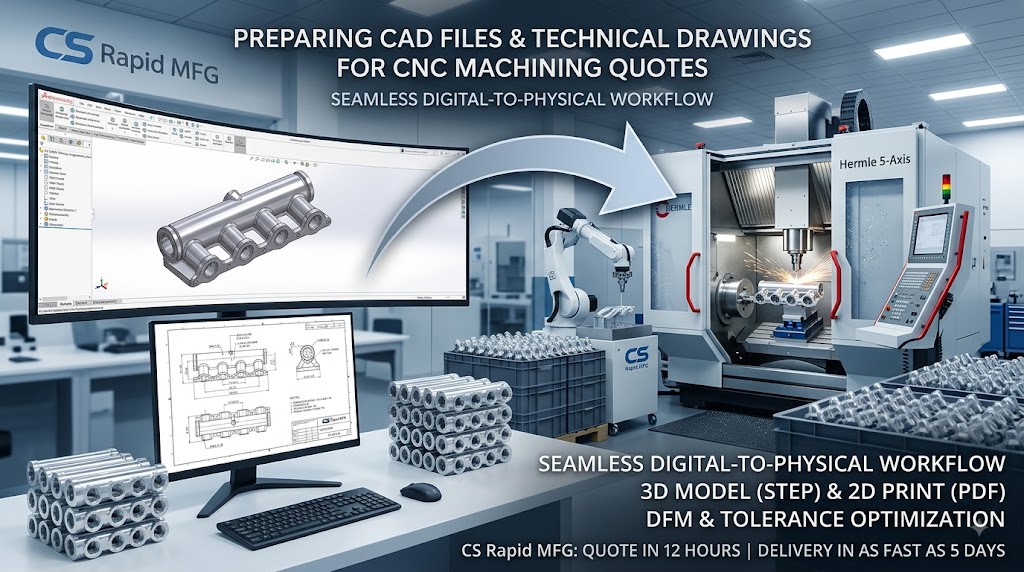
Partnering with an experienced vendor ensures your parts are backed by a robust [on-demand digital manufacturing ecosystem] for seamless scaling. Located in Dongguan, China, our advanced facility is proudly ISO 9001:2015 certified and backed by a team of over 100 skilled technicians. We house over 80 high-precision CNC machines, including Hermle and DUG 5-axis milling centers alongside advanced multi-axis lathes with live tooling.
Why Partner with CS Rapid MFG:
Rapid Delivery: We are committed to shortening pilot production cycles, delivering completed metal and plastic custom parts in as fast as 5 days.、
Zero MOQ Constraints: We support agile hardware development with no minimum order quantity (MOQ) required.
Preliminary DFM Support: Every inquiry receives a complimentary Design for Manufacturability (DFM) review within 12 hours, ensuring your parts are fully optimized for the most cost-effective process before cutting begins.
Ready to bring your CAD designs to life? Contact CS Rapid MFG today or upload your 2D and 3D files to receive a comprehensive, precise quote within 12 hours.