When manufacturing symmetrical, cylindrical components with extreme precision, few subtractive manufacturing methods can compete with CNC Turning. From simple pins and spacers to highly complex aerospace transmission shafts, CNC turning delivers outstanding repeatability, excellent surface finishes, and rapid production cycles.
In this article, we will demystify the CNC turning process, breaking down exactly how it works step-by-step, exploring how intricate operations like single point threading are achieved, and highlighting the extensive applications of this technology across various industries.
What is CNC Turning?
CNC turning is a specific form of precision subtractive machining in which a cutting tool removes material by making contact with a spinning workpiece. Unlike CNC milling—where the cutting tool rotates and moves around a stationary block of material—CNC turning operates on the opposite principle. In turning, the workpiece rotates at high speeds along a stationary vertical or horizontal axis, while a fixed shaping instrument moves around it on a linear path.
Because the process relies on the rotation of the material itself, it is naturally the most efficient and accurate method for creating round, tubular, or spherical shapes. The entire movement of the machinery is controlled by computer instructions, allowing for extreme precision and minimal human error.
Step-by-Step: How the CNC Turning Process Works
Transforming a digital design into a physical part requires a precise sequence of events. Here is how the CNC turning process typically unfolds on the factory floor:
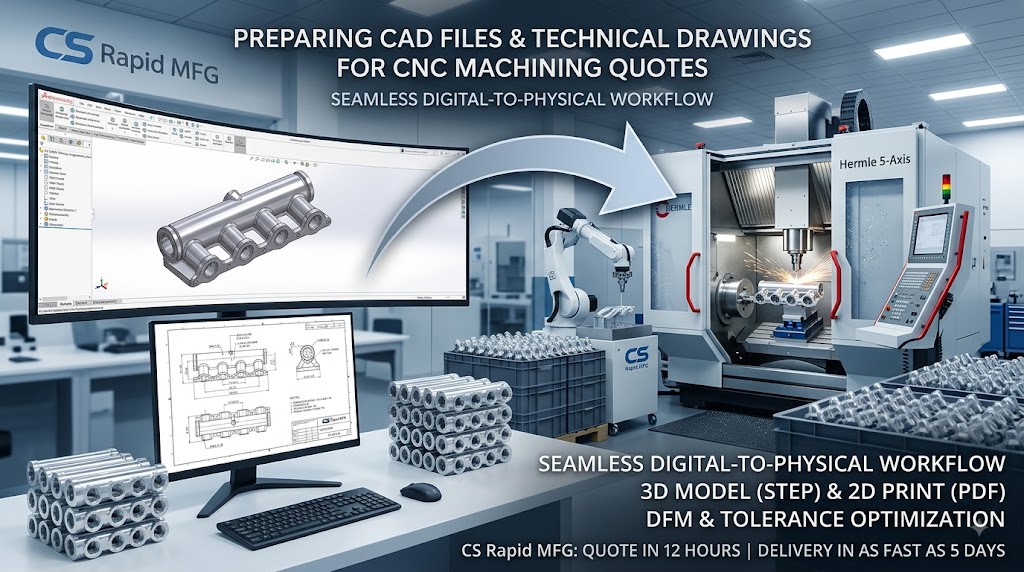
1. Programming (CAD to CAM) The initial step of the CNC turning process involves the preparation of a 3D CAD (Computer-Aided Design) file, which is then converted to a CAM program written in the G-Code language. This G-Code acts as the “brain” of the operation, dictating the exact feed rate, spindle speed, and tool paths the machine must follow.
2. Machine Setup and Tooling Before cutting begins, a machinist sets up the CNC lathe. A set of specific cutting tools—such as right-hand turning tools, left-hand tools, grooving tools, drills, taps, and parting tools—are mounted onto the machine’s tool changer or turret.
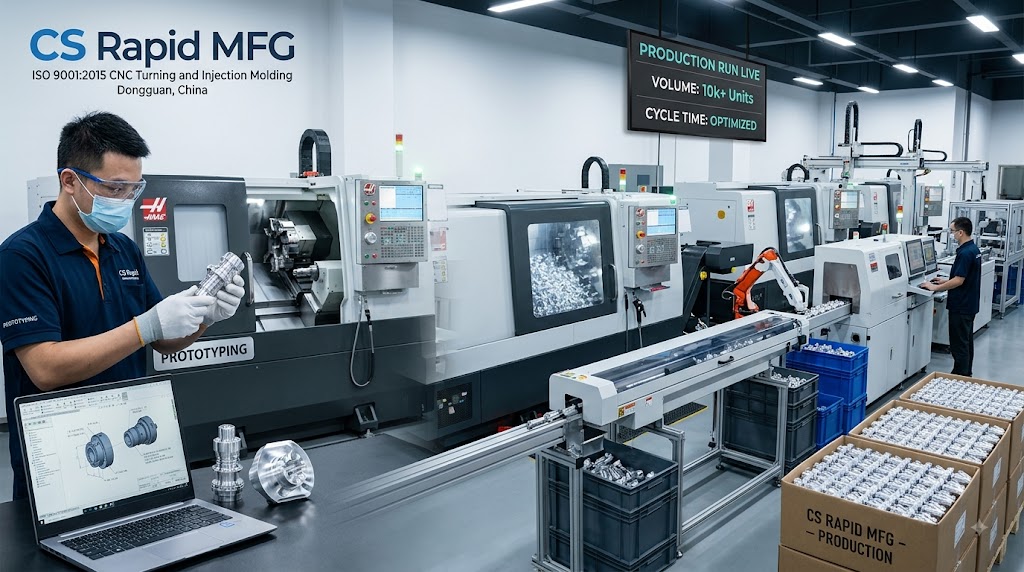
3. Loading the Material A blank bar of raw stock material is loaded into the lathe’s spindle and gripped tightly by the chuck. The chuck, which typically features 3 or 4 jaws, ensures the material remains perfectly centered and stable during high-speed rotation. For long production runs, modern CNC turning systems can be equipped with automatic bar feeders, which feed a continuous length of bar stock into the spindle to save labor costs and shorten delivery times4. Machining (Material Removal) Once the setup is complete, the spindle spins the workpiece up to the programmed speed. The stationary cutting tool is then brought into contact with the spinning material to progressively shave away the unwanted metal or plastic until the final desired 3D geometry is formed.
4. Machining (Material Removal) Once the setup is complete, the spindle spins the workpiece up to the programmed speed. The stationary cutting tool is then brought into contact with the spinning material to progressively shave away the unwanted metal or plastic until the final desired 3D geometry is formed.
5. First-Article Inspection & Production Typically, a run of one piece is completed first to verify that the tools and the CAM program are perfectly aligned. Once this “first-article” part passes rigorous quality inspection, full-scale production begins, and the machine can repeat the operation with little-to-no set-up time in between.
Common CNC Lathe Operations & Single Point Threading
A modern CNC lathe is an incredibly versatile machine tool capable of executing multiple distinct cutting operations on a single workpiece. Common operations include:
Turning (Rough and Finish): The most fundamental operation, which primarily removes material on the outside diameter (OD) of the raw bar. A “rough-cut” removes the bulk of unwanted material quickly, while “finish turning” is used to achieve the final dimensional accuracy, tight tolerances, and a smooth surface finish.
Facing: This operation involves moving the cutting tool across the flat end of the rotating workpiece to create a smooth, perpendicular flat surface.
Drilling and Boring: Drilling is used to create holes, typically down the center axis at the end of a bar.
Grooving: The tool is fed radially into the workpiece to cut a narrow groove on the outer or inner diameter, commonly used for seating O-rings.
Parting: Once all machining operations are completed, a parting tool is fed into the rotating workpiece to cleanly cut the finished part off from the remaining bar stock.
How is Single Point Threading Achieved?
Single point threading is an advanced operation used to cut highly precise internal or external helical threads into a workpiece. This process requires perfect synchronization: the cutting tool is moved in a synchronous fashion along the surface of the workpiece while the spindle rotates at high speeds.
The specifications of the thread—specifically the depth and angle of the groove—are strictly determined by three factors: the shape of the cutting tool, the feed rate, and the spindle speed. To protect the tool and ensure extreme precision, the thread is typically not cut in one go. The final thread is formed by advancing the cutting tool along the same helical groove multiple times, progressively deepening the cut until the required thread depth is perfectly achieved.
Industry Applications: Where is CNC Turning Used?
Because CNC turning offers incredible precision and smooth surface finishes, it is an indispensable manufacturing method across numerous demanding sectors:
Automotive & Transportation: The automotive industry heavily relies on CNC turning to produce parts that endure high pressure and friction. This includes engine components (such as cylinder heads, connecting rods, and camshafts), transmission parts (shafts and rings), and suspension components (sway bars, control arms, tie rod ends, and bushings).
Aerospace & Aviation: Aviation requires custom components with extreme tolerances. The industry depends on CNC turned parts for manufacturing sensor probes, joint connectors, aviation fasteners, and critical engine and aircraft components. Due to extreme temperature requirements, these parts are frequently turned from high-performance materials like titanium.
Construction & Heavy Equipment: The construction industry demands structural components capable of handling immense loads. CNC turning is widely used to manufacture high-strength bolts, screws, and fasteners from metals like stainless steel and aluminum for large assemblies.
Medical & Precision Instruments: Thanks to the high dimensional accuracy and exceptionally smooth surface finishes turning provides, it is perfectly suited for producing intricate surgical instruments and cylindrical medical components.
Rapid Tooling: Because the CNC turning process can be applied to virtually any hard material, it is an ideal and rapid solution for creating manufacturing fixtures or molds.
Serial Production: With vast material options, precise tolerances, and a high-quality finish, CNC lathe turning is a highly favorable technology for mass production. When combined with bar feeders that automate material handling, it enables highly repeatable, low-cost serial production.
Bring Your Turned Parts to Life with CS Rapid MFG
Understanding the intricacies of the CNC turning process highlights the need for a highly skilled manufacturing partner. Whether you are developing a rapid prototype for a new medical device or require low-volume serial production for automotive components, CS Rapid MFG is equipped to deliver.
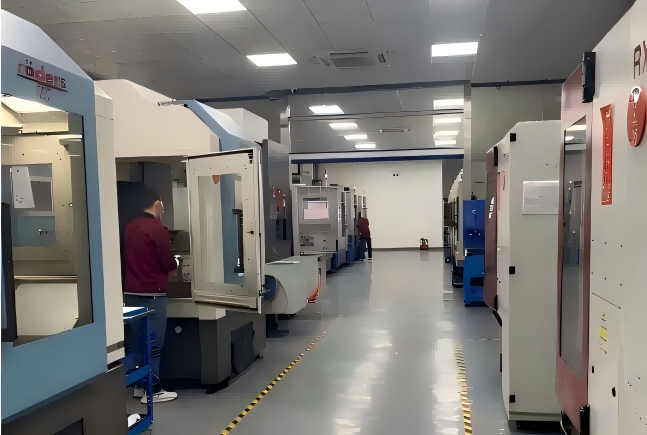
Established in 2008 and proudly ISO 9001:2015 certified, our facility is backed by a team of over 100 skilled and experienced professional technicians. We operate over 80 domestic and foreign high-precision CNC processing machines, ensuring that your parts meet exact dimensional tolerances.
Why trust us with your next CNC turning project?
Speed: We are committed to shortening pilot production cycles, with parts manufactured and ready for delivery in as fast as 5 days.
Flexibility: We support true agile development with No Minimum Order Quantity (MOQ) required.
Expertise: Upon receiving your inquiry, our engineers will provide a preliminary DFM (Design for Manufacturability) report to help you optimize your design for the lathe, saving you time and money.
With over 15,000 projects successfully delivered to satisfied customers worldwide, CS Rapid MFG provides a one-stop solution for customized high-quality products.
Ready to see your design turned into reality? Contact CS Rapid MFG today and share your 2D or 3D files for an instant quote within 12 hours.