With the rapid development of intelligent industry and bionic robots, the market faces unprecedented dual challenges in terms of machining precision and surface aesthetics for core robot structural components (such as robotic arms and lightweight joint links).
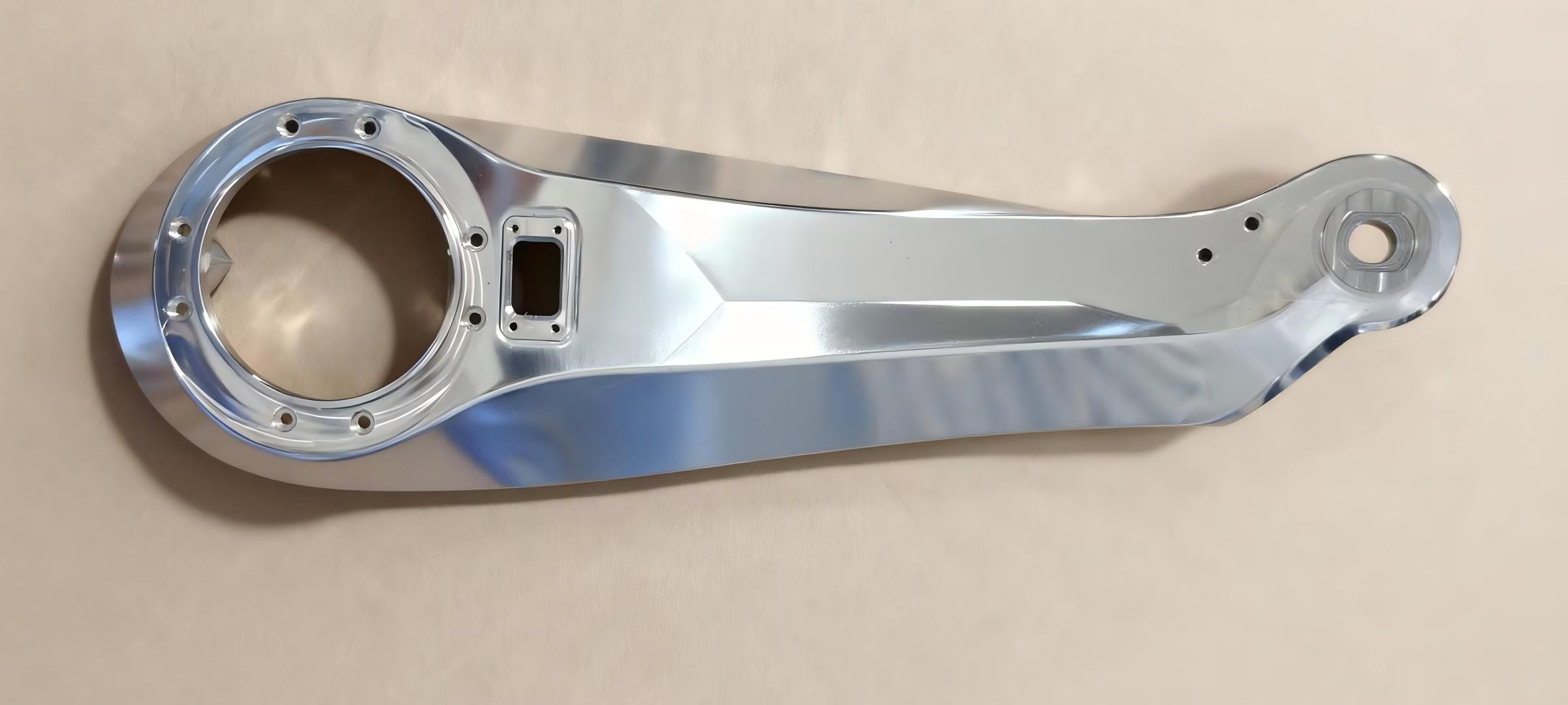
Recently, the CS MOLDING team successfully delivered a customized aluminum alloy joint structural component for a high-end intelligent robot to a client. This component not only needs to withstand high-intensity dynamic responses but also serves as a visible part of the robot’s appearance, demanding the highest standards for surface texture. The following is a comprehensive analysis of the project’s manufacturing process.
I. Machining Challenges and Technical Difficulties of Core Robot Components
In the field of robot manufacturing, every gram reduction and micrometer-level tolerance improvement directly impacts the robot’s operational accuracy and power consumption. After receiving the client’s 3D drawings, we identified the following core technical challenges:
- Machining of Irregularly Shaped Streamlined Surfaces: The workpiece exhibits an asymmetrical, gradually changing curved surface with complex chamfers and edges. Ordinary precision three-axis machine tools are prone to leaving minute “tool marks” or vibration marks at the junctions of arcs when switching cutting angles, affecting the fatigue life and overall aesthetics of structural components.
- Ultra-high precision geometric tolerance control: As a joint connector, this component integrates large-diameter main bearing assembly rings at both ends, multi-hole threaded blind holes, and a precision functional groove in the middle. To ensure that the robot does not experience physical jamming during high-speed operation after assembly, its coaxiality and geometric tolerances must be strictly controlled within ±0.01mm.
- A-grade mirror finish and lightweight balance: To achieve lightweight design, the workpiece features a deep cavity hollowing design. During high-speed cutting, thin walls are prone to slight deformation due to internal stress. Simultaneously, the customer requires the finished product surface to achieve a flawless mirror-like reflective effect.
II. CS MOLDING’s Multi-Axis CNC Machining and Surface Finishing Solutions
To perfectly overcome the above challenges, the CS MOLDING engineering team developed an integrated closed-loop process from high-speed milling to high-level polishing:
1. Five-Axis CNC Milling
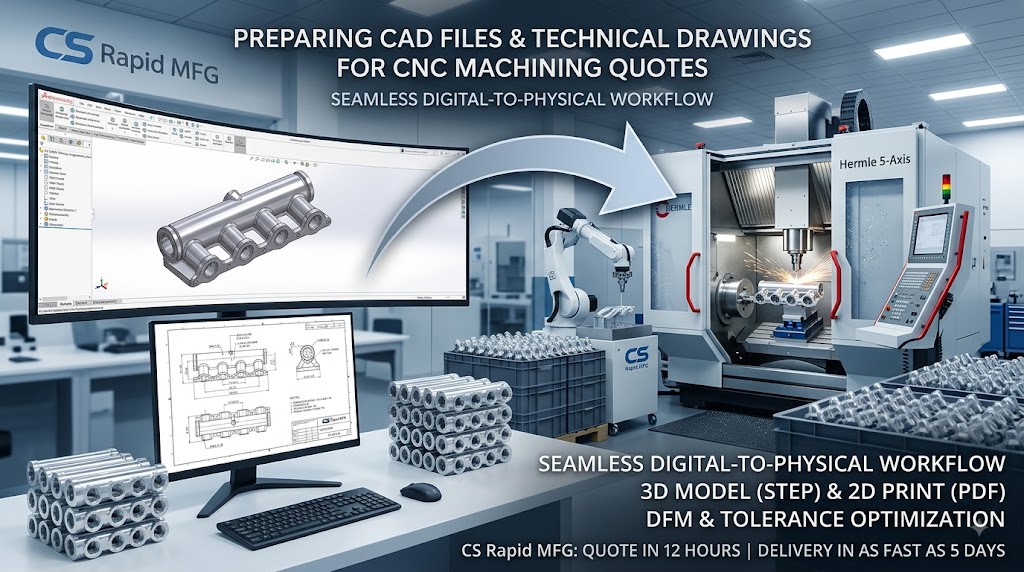
We selected high-strength, fatigue-resistant aerospace-grade aluminum alloys (6061-T6/7075-T6) as the base material. Utilizing an advanced five-axis CNC machining center, the cutting tool maintains the optimal cutting angle to conform to the streamlined surface. Through micron-level feed rate control, surface roughness is minimized during the milling stage, completely eliminating tool marks inherent in traditional machining.
2. Stress Relief and Single-Setup Deformation Control
To address the deformation risks of thin-walled structures, we employ a layered roughing approach to fully release the internal residual stress of the aluminum alloy material. During the finishing stage, a customized high-precision combination fixture is used for single-clamping and multi-faceted simultaneous machining, ensuring that the perpendicularity of the large end ring and the central square groove, as well as the assembly tolerance, meet the standards on the first attempt. Actual inspection tolerances are consistently within the ±0.01mm limit.
3. Advanced Mechanical and Manual Composite Polishing (Mirror Polishing)
After CNC precision milling, the part enters a rigorous surface treatment process. We perform multiple passes of mechanical rough polishing and fine polishing with different grits, culminating in a pure manual precision mirror polishing by experienced craftsmen. This process completely eliminates microscopic ripples on the metal surface, giving the aluminum alloy a mirror-like high-gloss texture, significantly enhancing the robot’s technological feel and high-end brand positioning.
III. Why Choose CS MOLDING as Your Robot Hardware Partner?
As a company specializing in high-precision customized manufacturing, CS MOLDING possesses extensive experience in B2B industrial-grade customer service and is able to accurately understand and implement stringent international industry technical standards.
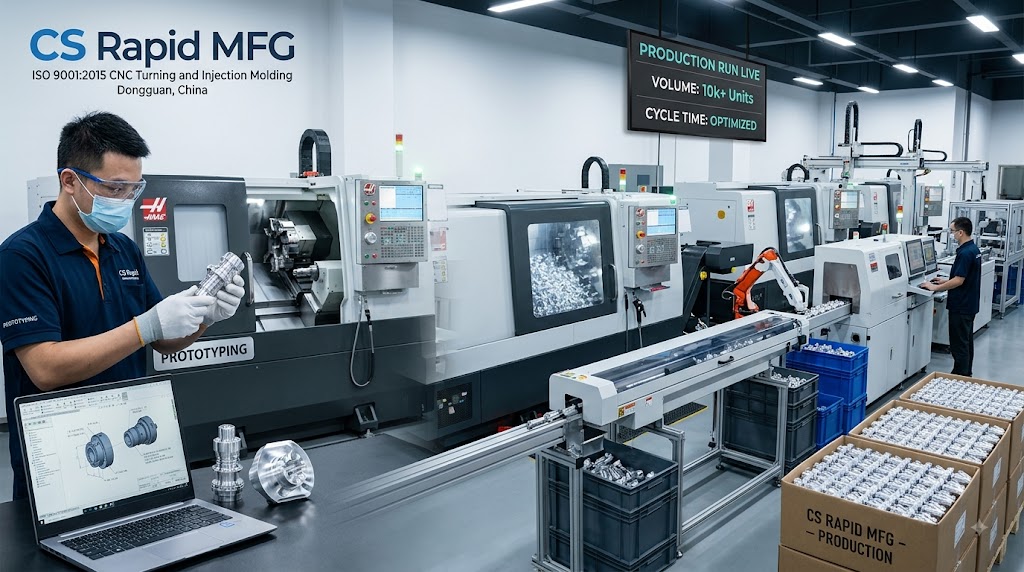
One-stop customization capabilities: We not only possess strong expertise in precision CNC machining, but also provide high-quality sheet metal processing and precision injection molding services, capable of meeting the complete manufacturing needs of robot shells, internal skeletons, and gear joints.
Strict quality control: From incoming raw material spectral testing to final dimensional inspection using coordinate measuring machines (CMM), we ensure that every component delivered to you is 100% in compliance with drawing specifications.
Contact us
If you are developing robots, drones, medical devices, or automation hardware and require high-precision components with demanding design and appearance requirements, please feel free to send your 3D drawings (STEP/IGS format) to our official email address.
contact us.Our CS MOLDING engineering team will provide you with a professional DFM manufacturability analysis report and a highly competitive quote within 24 hours!