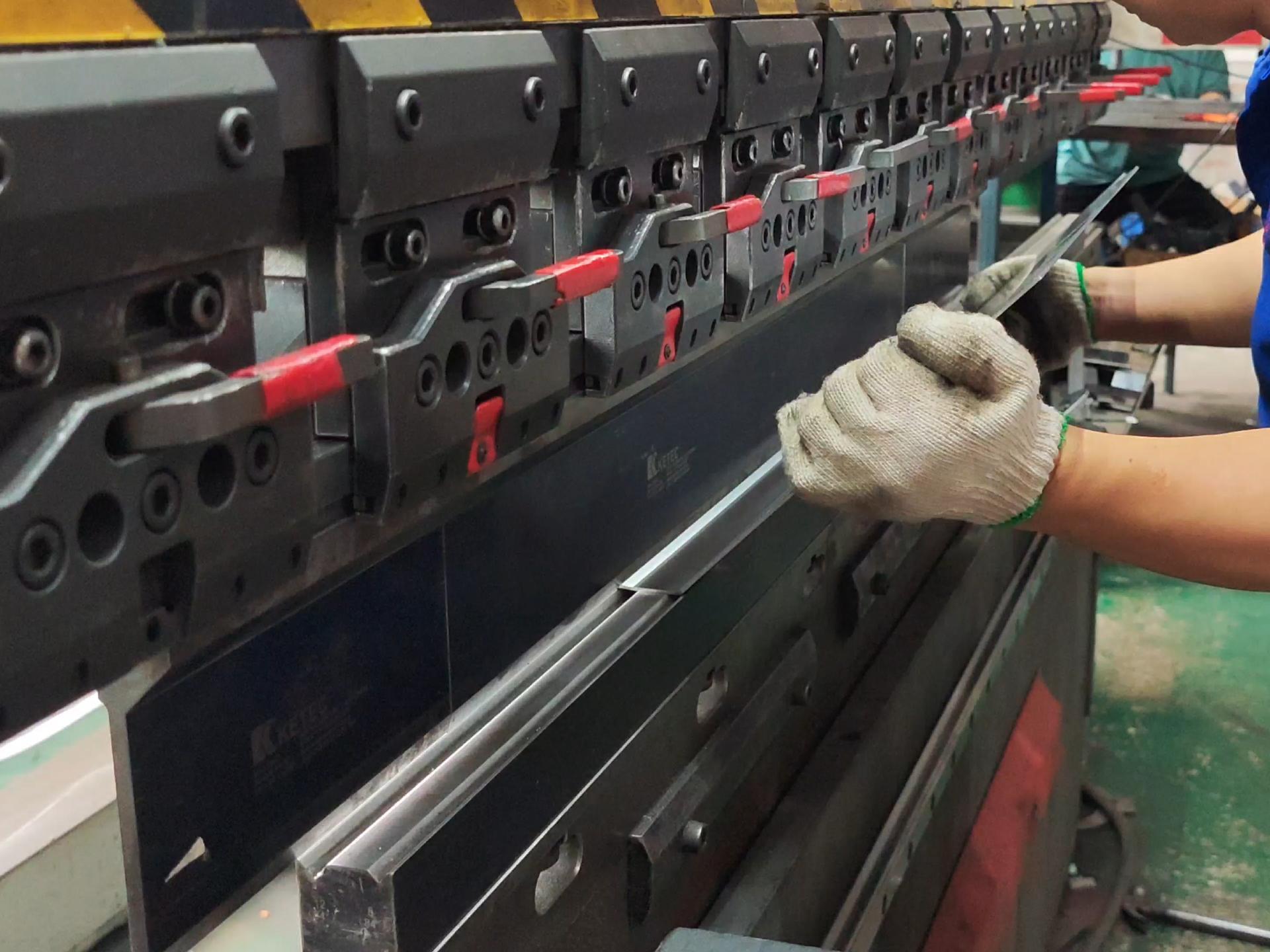
In today’s highly competitive manufacturing landscape, “Design for Manufacturability” (DFM) is no longer an option—it is an absolute necessity. Even minor oversights in sheet metal part design can lead to increased costs, production delays, or quality issues.
Drawing upon practical manufacturing experience, the following list outlines some of the most common errors encountered in sheet metal design—along with how to avoid them.
1. Improper Bend Radii
One of the most common issues in sheet metal design is specifying unrealistic bend radii.
- The Problem: A bend radius that is too small can cause the material to crack, particularly with harder materials.
- Best Practice:The inside bend radius should typically be equal to or greater than the material thickness.
Tip: Different materials (e.g., stainless steel vs. aluminum) possess vastly different characteristics—always take the specific properties of the material into account.
2. Holes Placed Too Close to Edges or Bends
Placing holes too close to an edge or a bend line can result in deformation or tearing during the forming process.
- The Problem: After bending, the holes may become deformed or lose their dimensional accuracy.
- Best Practice:
Distance from hole to edge ≥ 1.5 × Material Thickness
Distance from hole to bend line ≥ 2–3 × Material Thickness
3. Neglecting K-Factors and Bend Allowances
Creating an accurate flat pattern (unfolded layout) for sheet metal relies heavily on precise bend calculations.
- The Problem: An incorrect flat pattern layout can result in parts that do not fit together properly during assembly.
- Best Practice: Use accurate K-factors or bend allowances in your calculations, based on the specific tooling and material being used.
Expert Insight: This is precisely where experienced manufacturers demonstrate their true value—relying solely on standard lookup tables is often insufficient.
4. Overly Tight Tolerances
Excessively tight tolerance requirements can exponentially increase costs without necessarily providing a corresponding increase in value.
- The Problem: Unnecessary precision requirements can slow down production and drive up inspection costs.
- Best Practice:
Specify tight tolerances only for specific features where they are functionally essential.
5. Incorporating Complex Manufacturing Features
Including unnecessary complex features in a design can significantly prolong the time required for production.
- Examples of Issues:
Excessive small bends
Irregularly shaped cutouts or perforations
Features that are difficult to access or machine - Best Practice:
Simplify geometric shapes whenever possible.
6. Lack of Standardization
Using non-standard hole diameters, thread specifications, or materials can create challenges for procurement and tooling setup.
- Issue: Leads to extended lead times and increased production costs.
- Best Practice:
Adhere to standard tooling specifications and select common, commercially available materials.
7. Improper Material Selection
Material selection directly impacts a product’s manufacturability and cost.
- Issue: Selecting materials that are difficult to form or expensive when not strictly necessary.
- Best Practice:
Select materials based on the following factors:
Strength requirements
Corrosion resistance
Formability
8. Failure to Consider Surface Finishes Early On
Surface finishing is often treated as an afterthought.
- Issue: Certain surface finishing processes (e.g., powder coating, anodizing) can affect part dimensional accuracy and assembly fit.
- Best Practice:
Incorporate surface finishing requirements during the design phase.
9. Missing or Unclear Technical Drawings
Even a well-designed part can result in manufacturing failure if the accompanying technical documentation is unclear.
- Issue: Poor communication can lead to manufacturing errors, project delays, or rework.
- Best Practice:
Ensure drawings include the following key information:
Clear dimensional callouts
Tolerance requirements
Material specifications
Surface finishing requirements
Conclusion
Avoiding the common DFM (Design for Manufacturability) errors listed above can significantly boost project efficiency, reduce costs, and shorten lead times.
At CS MOLDING, we do more than just manufacture parts—we are dedicated to helping you optimize your designs for mass production. Our engineering team works closely with clients to identify potential issues early on, ensuring a smooth and cost-effective manufacturing process.
Seeking DFM Support?
If you are embarking on a new sheet metal project or would like to receive expert third-party advice on an existing design, please feel free to contact us. Let us help accelerate the realization of your designs, enabling mass production in a more efficient and intelligent manner.
Would you like to receive a cost optimization proposal for your current project? Please feel free to contact us; we will provide you with a detailed quotation and expert recommendations within 24 hours.