When sourcing precision parts, many clients often overlook the decisive impact that the design phase (DFM) has on overall costs. In fact, approximately 70% of manufacturing expenses are already locked in by the time the design is finalized.
As a professional manufacturing partner, CS MOLDING has compiled the following practical CNC optimization strategies, designed to help you significantly reduce machining costs without compromising on quality.
1. Optimize Internal Fillets
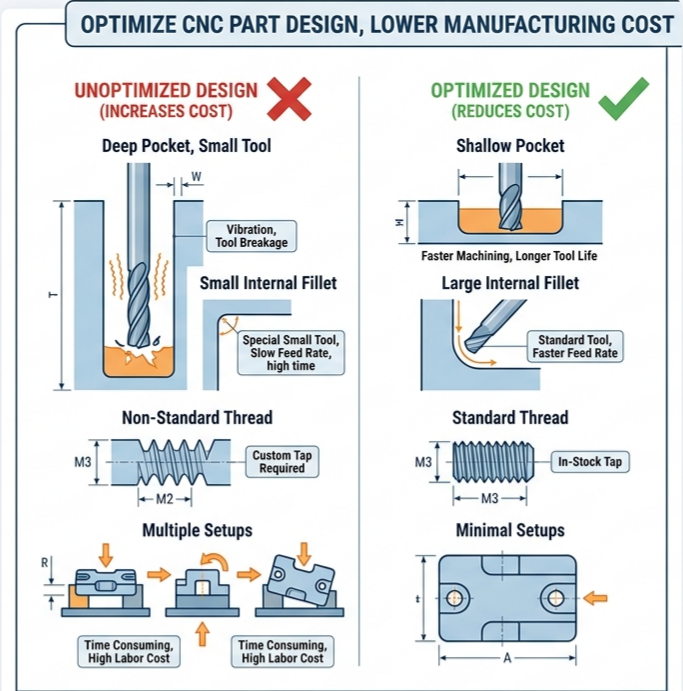
CNC cutting tools (milling cutters) are typically cylindrical; this means that when machining internal corners, they inevitably leave behind rounded fillets.
- Cost Pain Point: If you design a sharp, 90-degree internal corner, we are forced to use extremely small tools—often requiring multiple Electrical Discharge Machining (EDM) passes or specialized processes—to clean out the corner, which drastically increases machining time.
- Optimization Suggestion: Ensure that the radius of the internal fillet is slightly larger than the radius of the cutting tool. For example, if you plan to use a 6mm diameter tool, it is recommended to design the internal fillet with a radius of 3.2mm or greater. This allows the tool to pass through at high rotational speeds, thereby boosting machining efficiency.
2. Avoid Deep Pockets (Deep Cavities)
Deep and narrow cavities are a machinist’s nightmare.
- Cost Pain Point: Holes or slots with a depth exceeding six times their diameter require specialized, extended-reach cutting tools. These tools are highly prone to vibration (chatter), which degrades surface finish and increases the risk of tool breakage, forcing the machine to operate at reduced speeds.
- Optimization Suggestion: It is recommended to limit cavity depth to within four times the tool diameter. If a deep cavity design is unavoidable, consider splitting the part into multiple components that can be assembled together.
3. Standardize Thread Specifications and Depths
- Cost Pain Point: Using specialized, non-standard thread specifications necessitates the procurement of custom taps. Furthermore, the deeper a thread is designed, the greater the risk of tap breakage during machining.
- Optimization Suggestion: Whenever possible, utilize standard thread specifications (such as M3, M4, M5, or Imperial 1/4-20). Thread depth typically does not need to exceed three times the hole diameter; threads deeper than this threshold do not significantly increase joint strength but instead serve only to increase machining difficulty.
4. Minimize Setups (Setup Changes):
The most time-consuming aspect of CNC machining is often not the actual cutting, but rather the fixturing and tool setting.
- Cost Pain Point: If a part requires machining on six different faces, the operator must frequently flip and re-align the part.
- Optimization Suggestion: Whenever possible, design all machining features to be located on a single face—or on the fewest number of faces possible. If all cutting operations can be completed within a single setup, manufacturing costs will decrease significantly.
5. Set Tolerances Sensibly (Tolerance Control)
- Cost Pain Point: Not every dimension on a part requires a precision of ±0.01mm. Excessively tight tolerance requirements can lead to higher scrap rates, as well as the need for more frequent quality inspections and specialized machine tool calibration.
- Optimization Suggestion: Apply tight tolerances only to critical mating surfaces. For non-critical areas, utilize standard industrial tolerances (such as ISO 2768-m); this approach can significantly accelerate production speeds.
6. Select Materials with Good Machinability
- Cost Pain Point: Certain hard metals (such as titanium alloys or 316 stainless steel) offer excellent performance characteristics but are slow to machine and cause rapid tool wear.
- Optimization Suggestion: If the application allows, prioritize materials with superior machinability—such as Aluminum 6061 or Brass. For an identical part, the cost of machining aluminum alloy is typically far lower than that of stainless steel.
Conclusion
At CS MOLDING, we serve as more than just your manufacturing partner; we are also your engineering consultants. Before we proceed with formal mold making or machining, our engineering team conducts a complimentary Design for Manufacturability (DFM) review of your 3D models, aiming to identify every potential opportunity for cost savings.
Would you like to receive a cost optimization proposal for your current project? Please feel free to contact us; we will provide you with a detailed quotation and expert recommendations within 24 hours.